

Winback Recover+ After a Swim and 5K: What My Tests Showed

Hector L. Torres, MS, MHS | September 16, 2026
Owner & Head Coach, Tri Peak Athlete | USA Triathlon Level III Coach
Disclosure: I also serve as U.S. & Puerto Rico Business Development Manager for Winback USA.
After swimming and running this morning, I used Winback BACK4 Recover+ and checked my force output with Kinvent K-Pull. By the final test, hip-extension force was higher on both sides. Knee-flexion force remained below my starting values. Both findings belong in the report. [S1–S6]
What I did
My workout files recorded a 1,950-yard swim in 52:02 and a 5.00 km run in 33:46 of timer time. Average heart rates were 109 and 144 bpm, respectively. The run ended at 9:12 a.m. [T1–T2]
| Testing point | Hip extension | Knee flexion at 90° |
|---|---|---|
| After training, before treatment | 9:38 a.m. | 9:41 a.m. |
| After Recover+ with calf pads | 10:21 a.m. | 10:23 a.m. |
| After Recover+ with quad pads | 11:35 a.m. | 11:32 a.m. |
The first treatment occurred between 9:41 and 10:21 a.m.; that window is not a confirmed treatment duration. Pad locations and treatment order come from my session account. Exact session durations and device settings were not supplied.
K-Pull measures pulling force. Here, hip extension means pushing the leg backward; knee flexion means bending the knee against resistance. These tests do not directly measure quadriceps strength, muscle recruitment, or tissue healing. [K1]
What changed
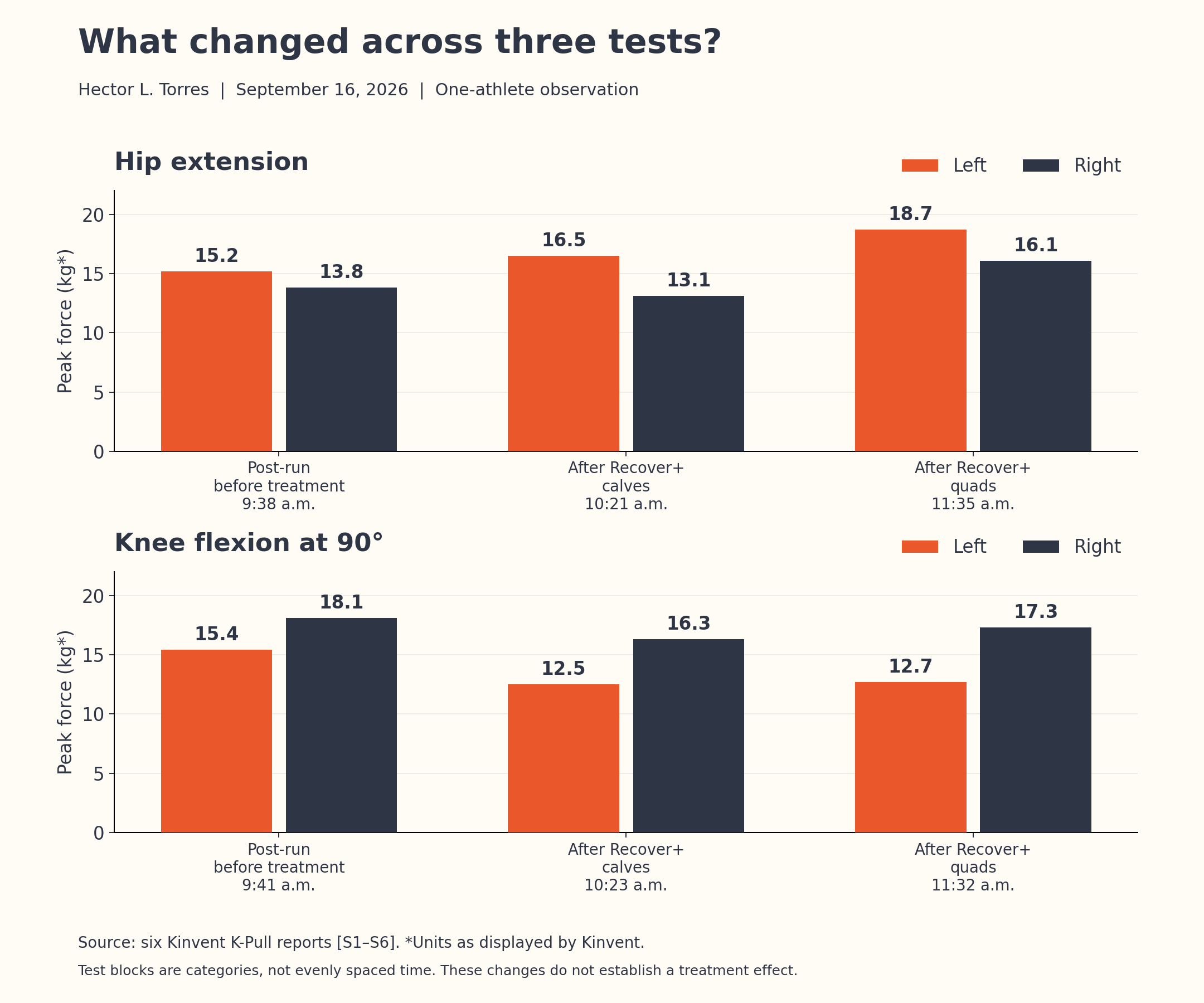
Figure 1. All three testing blocks, using units displayed by Kinvent. Sources: S1–S6.
- Hip extension: left peak force rose from 15.2 to 18.7 kg (+23.0%); right rose from 13.8 to 16.1 kg (+16.7%).
- Knee flexion: left peak force finished at 12.7 versus 15.4 kg (−17.5%); right finished at 17.3 versus 18.1 kg (−4.4%). Both improved slightly from the middle test.
These percentages compare the final test with the initial post-run test—not a rested baseline. They were calculated from the rounded force values shown in the reports.
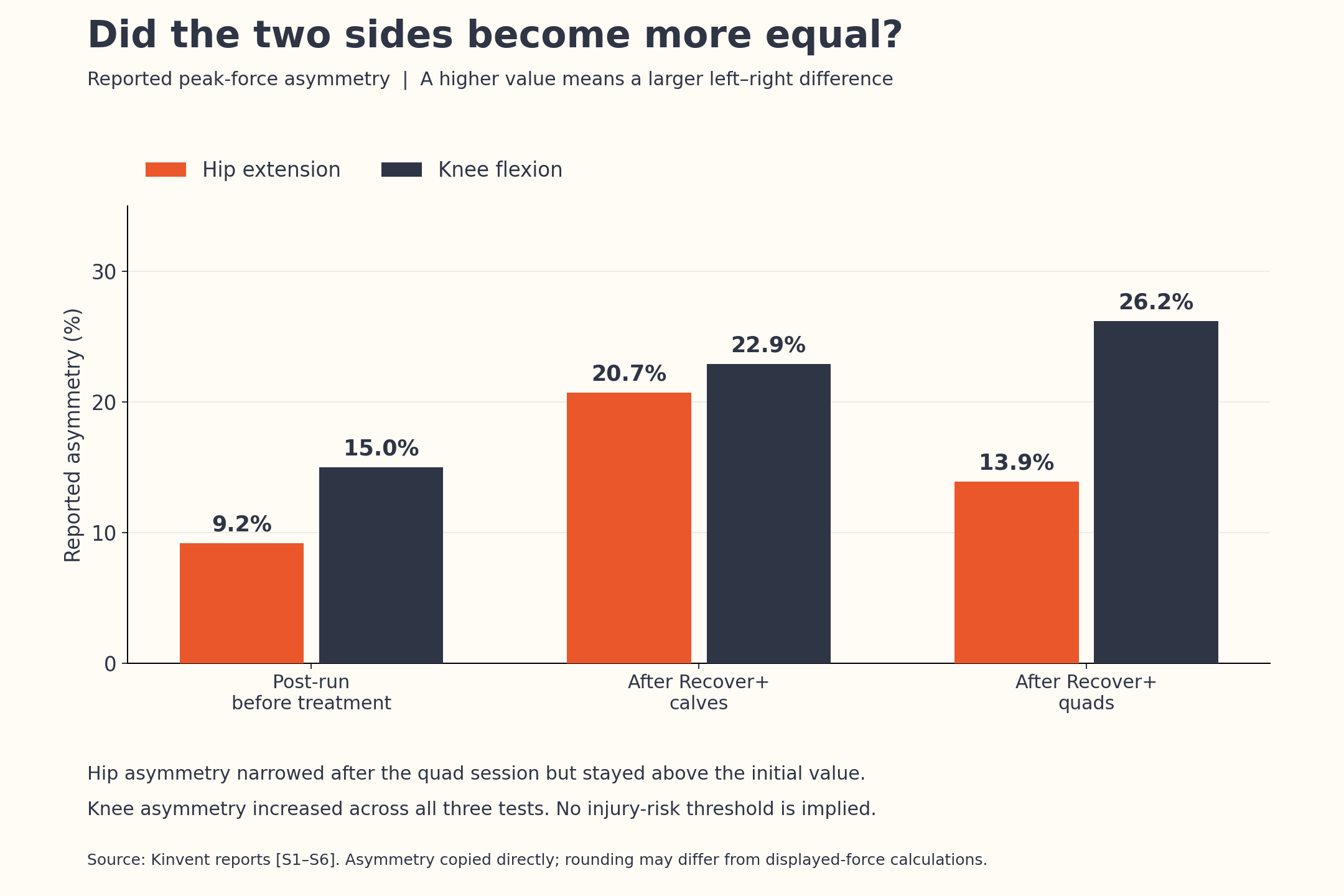
Figure 2. Asymmetry means the difference between the two sides. Hip-extension asymmetry ended at 13.9% versus 9.2% initially; knee-flexion asymmetry ended at 26.2% versus 15.0%. These values are not injury diagnoses. Sources: S1–S6.
READyOS: how the score changed
READyOS added a separate view of my morning. Four scores come from the supplied reports; I supplied all scan times and the additional 18/100 reading. Its report PDF is still pending. [R1–R5]
| Time | Score / 100 | Where it falls in the morning |
|---|---|---|
| 5:06 a.m. | 100 | Before morning training |
| 8:24 a.m. | 60 | After swimming, before the run |
| 9:28 a.m. | 18* | After the run, before treatment |
| 10:20 a.m. | 49 | After Recover+ with calf pads |
| 11:00 a.m. | 67 | Later follow-up; timing relative to the quad session unconfirmed |
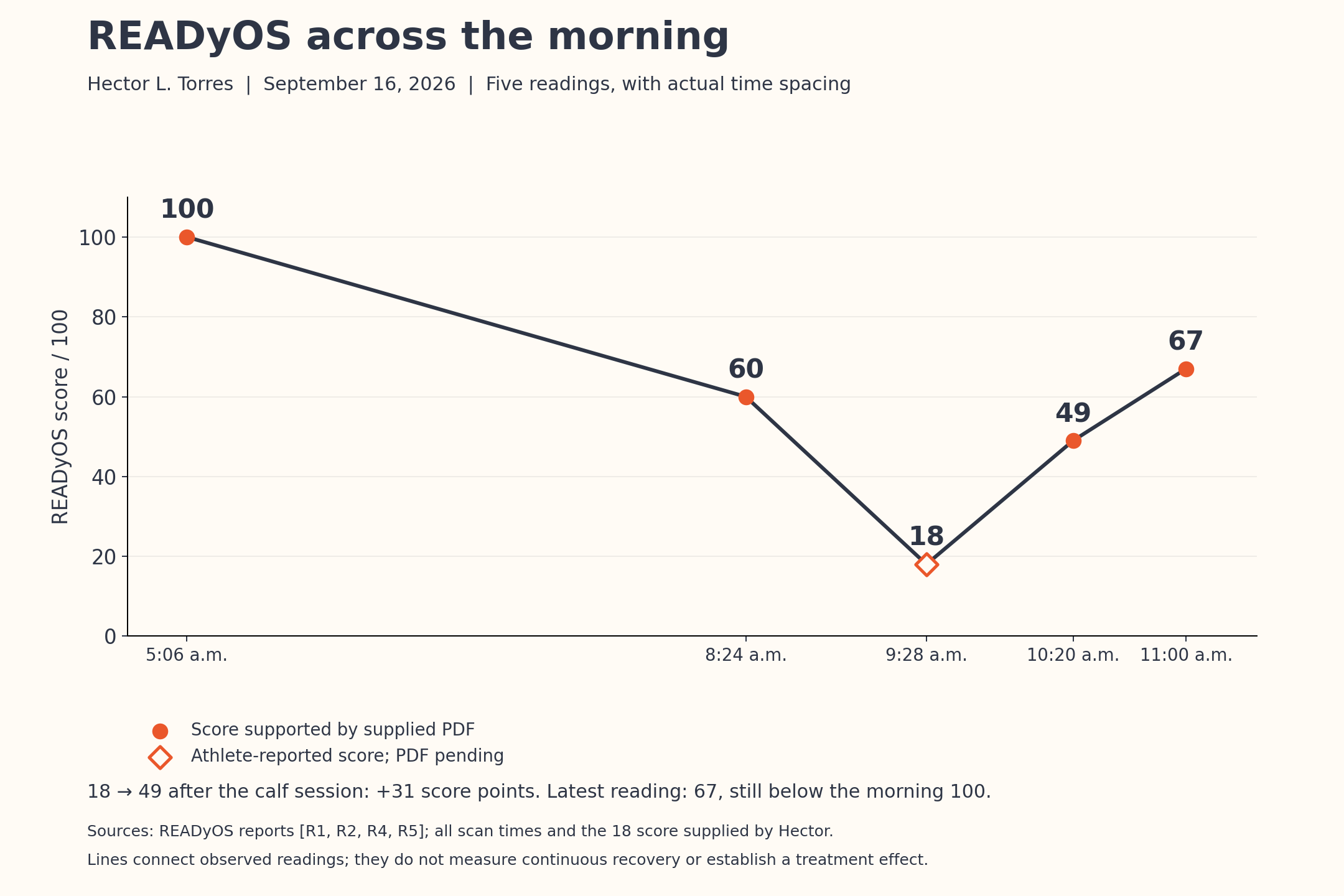
Figure 3. The score rose 31 points, from 18 to 49, between the post-run reading and the reading after calf Recover+. It reached 67 at 11:00 a.m., 49 points above the post-run low but still below the early-morning score. These are score-point changes, not percentages of energy restored. The hollow diamond marks the athlete-reported reading. [R1–R5]
The 10:20 and 11:00 reports also show average heart rate changing from 83 to 72 bpm, and RMSSD (an HRV measure) from 13.09 to 20.49 ms. The 18-score report was not supplied, so I cannot make the equivalent raw-data comparison across the calf session. [R4–R5]
This score rebound and the mixed force results describe different measurements. Neither alone establishes complete recovery or how much change was due to Winback rather than rest and elapsed time.
What I take from this
The final hip-extension result improved, but recovery was not uniform across tests. This is one athlete, one morning, without a rest-only comparison. Time, repeated effort, positioning, and test order could influence the results; the final block reversed the earlier test order. The 10:23 report also recorded VAS 5/10, but the symptom and location were not documented. The measurements do not establish that Winback caused the changes or that the changes exceeded normal test variation.
As a coach, I want to know what happens beyond the treatment table: how an athlete feels later and whether they can complete the next planned session. That is what I want this recovery-monitoring approach to help us track.
Interested in exploring BACK4 and a measurement workflow for your practice? Email hector@winback.com.
Sources and measurement record
Primary evidence: Hector Torres’s six Kinvent K-Pull reports, September 16, 2026. The companion source-report PDF reproduces their measurement pages; the CSV maps each ID to the original filename.
| Source | Test | Session time |
|---|---|---|
| S1 | Hip extension | 9:38 a.m. |
| S2 | Knee flexion at 90° | 9:41 a.m. |
| S3 | Hip extension | 10:21 a.m. |
| S4 | Knee flexion at 90° | 10:23 a.m. |
| S5 | Knee flexion at 90° | 11:32 a.m. |
| S6 | Hip extension | 11:35 a.m. |
T1–T2: Garmin pool-swim FIT export and Apple Watch run FIT export, September 16, 2026; original filenames are in the publishing notes. Workout and treatment data are observational records, not independent validation.
K1 — Instrument reference: Kinvent: K-Pull traction dynamometer. Manufacturer documentation supports the description of the measuring tool, not the treatment outcome.
Background reading: Lupowitz LG, Ramus L, Delacour F, Johnson K. TECAR Therapy: A Clinical Commentary on its Evolution, Application, and Future in Rehabilitation. International Journal of Sports Physical Therapy. 2025;20(4):632–640. This is a clinical commentary (level 5 evidence), not proof of this session’s effects.
READyOS sources: R1 = readyos-report-2329.pdf (100); R2 = readyos-report-2330.pdf (60); R3 = Hector’s reported reading (18; PDF not supplied); R4 = readyos-report-2334.pdf (49); R5 = readyos-report-2337.pdf (67). All reports are dated September 16, 2026. All scan times were supplied by Hector. The companion readyos-measurements.csv records the score, available heart-rate/HRV values and provenance for each point. The 11:00 scan is not labeled “post-quads” because that treatment’s exact timing is unconfirmed.
Reports:
Kinvent measurements:
Ready Os Meausrements:
Source Reports:
Discover more from
Subscribe to get the latest posts sent to your email.


